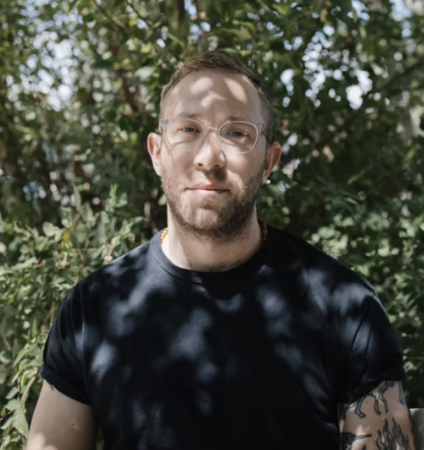
At night my dad used to tell stories. Helen of Troy, The Old Man and the Sea, The Fall of Icarus. The Old Man and the Sea was my favorite. I’ll never forget that image of the bones of the fish pulled up upon the shore at the end, with the old man lying beside them exhausted and defeated, the townspeople gathered all around, in awe. I’ve come to understand that my duty as a writer is to do just this, to go out into some wild place beyond the world, wrestle with those things which terrify us and bring back the bones for all to witness.
I was born and raised in Gilpin County, Colorado, then went and traveled the world and started writing on the subway in New York City when I was 21. Later, I went to the Jack Kerouac school of Disembodied Poetics. My time at the MFA was mostly disheartening and I was so burnt out by it that I moved up to a cabin in the woods for four years, where I worked construction, chopped wood, carried water and fell in and out of love and most importantly wrote. It was during this time, up there in the woods wrestling with all the beasts of the world, that I wrote what would become my first published works.
I now have six published books and three more books forthcoming in 2026.One is a manuscript co-written by Ashley Howell Bunn called Living Amends with Daxson Publishing. The second is the poetry collection Buffalo Elegies, out with Middle Creek Press, and finally, a novella through Anxiety Press called Death of the Father.
I’m currently at work on two new collections of poetry, a historical fiction novel, and two novellas. When I am not writing, I teach workshops across the front range and online, do handyman work, martial arts and meditate in my backyard. I post a weekly poem at alexandershalomjoseph.substack.com.